




Appointments
Request Appointment/Request Exam - After completing the respective forms, these requests will be processed by our services, and you will receive confirmation by email. The indications about the Agreements (Insurance/Subsystem) are merely informative, please request confirmation in the "Observations" field.
Schedule Appointment/Exam myHPA - By accessing myHPA Saúde you can make the appointment in real time, directly on the Doctor's schedule according to his availability.
You can also contact us at +351 282 420 400 Algarve | +351 269 630 370 Alentejo | +351 291 003 300 Madeira
Phone booking/service hours:
Monday to Friday: 8:00 AM to 7:00 PM, Saturday: 8:00 AM to 5:00 PM Sunday and Holidays: Closed
(National landline)
Your request has been successfully received. We will confirm your appointment shortly.
Download myHPA Saúde:


Herpes Zoster
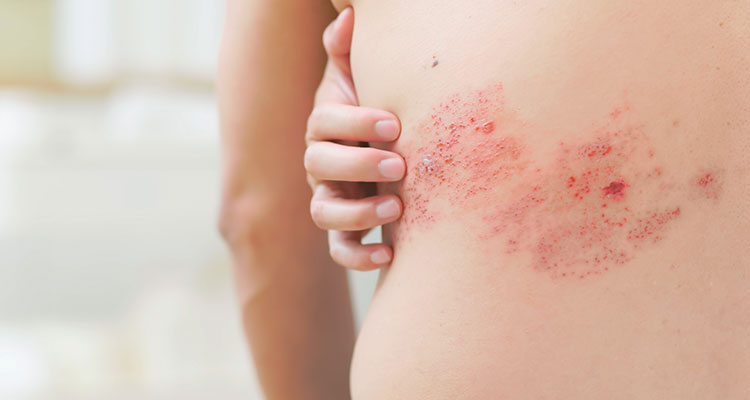
Herpes zoster, also known as shingles, is a reactivation of the varicella-zoster virus, which remains latent in the body after initial chickenpox infection. Although more common in older adults, it can occur at any age, especially in individuals with a weakened immune system.
Symptoms
The first sign is usually localized pain or burning, accompanied by skin sensitivity. Within a few days, red lesions develop, evolving into small grouped blisters (vesicles), often along a dermatome (skin area supplied by the same sensory nerve). These eruptions can be very uncomfortable and are frequently accompanied by fever. When affecting the face, particularly the eyes, the condition can be more severe and requires immediate attention.
Causes
Herpes zoster occurs due to the reactivation of the varicella-zoster virus, which remains inactive in nerve ganglia after chickenpox. Factors such as aging, immune suppression, stress, or certain medications may trigger reactivation. Adults over 50, immunocompromised patients, or those who have never received the varicella vaccine are at higher risk.
Impact and Complications
The most common complication is postherpetic neuralgia, where burning or electric-shock-like pain persists after lesions heal. This pain can be debilitating and last for months. Other complications include secondary infections, vision loss if the eye area is affected (herpes zoster ophthalmicus), and, rarely, encephalitis, which requires urgent hospital treatment.
Diagnosis and Medical Care
Diagnosis is based on symptoms and the characteristic lesion pattern. Treatment includes antivirals such as acyclovir or valacyclovir, ideally within the first 72 hours, to reduce severity and accelerate recovery. Pain relief and topical medications help alleviate symptoms. In more complex cases, specialised treatments such as nerve blocks may be indicated.
Prevention
Vaccination is the most effective preventive measure. Available for adults over 50 or at-risk groups, the vaccine significantly reduces the likelihood of developing shingles. Additionally, maintaining a strong immune system through a balanced diet, exercise, and stress management contributes to prevention.
The virus is transmitted via direct contact with vesicle fluid or indirect contact with contaminated objects. The contagious period can last up to 2 weeks, and the incubation period is 2–4 days after exposure to an infected person.
- Dr. André Laureano
- Dr. Duarte Flor
- Dra. Virginia Coelho de Sousa
- Dr. João Guilherme do Patrocínio
- Dra. Bárbara Roque Ferreira
- Dra. Cristina da Silva Sousa
- Dr. De Lorenzo
- Dr. João Guilherme do Patrocínio
- Dr. Vitor Neto
- Dra. Christine Schoutens
- Dr. Bruno Duarte
- Dr. João Guilherme do Patrocínio
- Dr. Pedro Vale Fernandes
CUF Alvor Hospital
Hospital São Camilo - Portimão
CUF Chinicato - Lagos Clinic
CUF Guia - AlgarveShopping Clinic
CUF Montenegro - Faro Clinic
CUF S. Brás de Alportel Clinic
CUF Sines Hospital
Beja Private Clinic
CUF Funchal Clinic
| Find all the information regarding Specialities and Consultations at CUF Healthcare Units in Greater Lisbon, the North, Centre, and the Azores here. |